

T
E
R
R
O
I
R
S
W
I
N
E
S
U
K
E
X
C
L
U
S
I
V
E
·
·
Domaine Guiborat
Four generations sold the fruit. Richard kept three and a half hectares back.
A Cramant grower that should be on every Côte des Blancs lover’s list. Richard and Karine Fouquet have made their wines from old-vine Chardonnay on the deep chalk of Cramant, with no malolactic and almost no dosage, for nearly twenty years. The result is electric and unmistakably of the Côte des Blancs.
At a glance
BASED IN
Cramant
Côte des Blancs, Champagne
FIRST VINTAGE
1996
About six thousand bottles
UNDER VINE
Three and a half hectares
Ring-fenced from the family’s eight
FARMING
Organic in practice, uncertified
No herbicides or insecticides since 2011
PRODUCTION
Around 30,000 bottles
Across four cuvées
UK
Exclusive to Terroirs
From 2026
The story
Doing it right, before it was fashionable

The Guiborat family first planted on the Cramant chalk in 1885. Four generations later, the man who runs the place grew up in a Paris suburb, and came back only because he had promised his grandmother he would. Richard Fouquet kept that promise, and built one of the most distinctive addresses on the Côte des Blancs.
Ce n’était pas un rêve, c’était comme ça, une évidence.
It was not a dream, just an obvious decision. Richard Fouquet
He came back in 1993, aged eighteen, to study at Avize and Reims. He joined his grandmother on the estate in 1995 and made his first vintage the following year, at twenty-one, a little under six thousand bottles. Then came the radical part: he ring-fenced three and a half hectares of the family’s best Grand Cru holdings for his own wines, while the fruit from the rest went on being sold to the big houses, as it still is.
Karine, an oenologist by training, came into Richard’s life in 2007 and joined the domaine full time in 2012. She admits she had been afraid she might not like his wines, and would not have known how to tell him. As it turned out, he was already making them very well.
Paulette, his grandmother, had run the estate alone since 1953 and saw through the digging of the cellar that had been started by hand in 1905. She lived on the domaine until her death in 2017, long enough to see the promise kept.
“Chalk terroir, Chardonnay, no malolactic fermentation, and old vines; this is our Magic combo.”
RICHARD FOUQUET
Vineyard and cellar
What happens in the vines, and what does not happen in the cellar.
In the vineyard

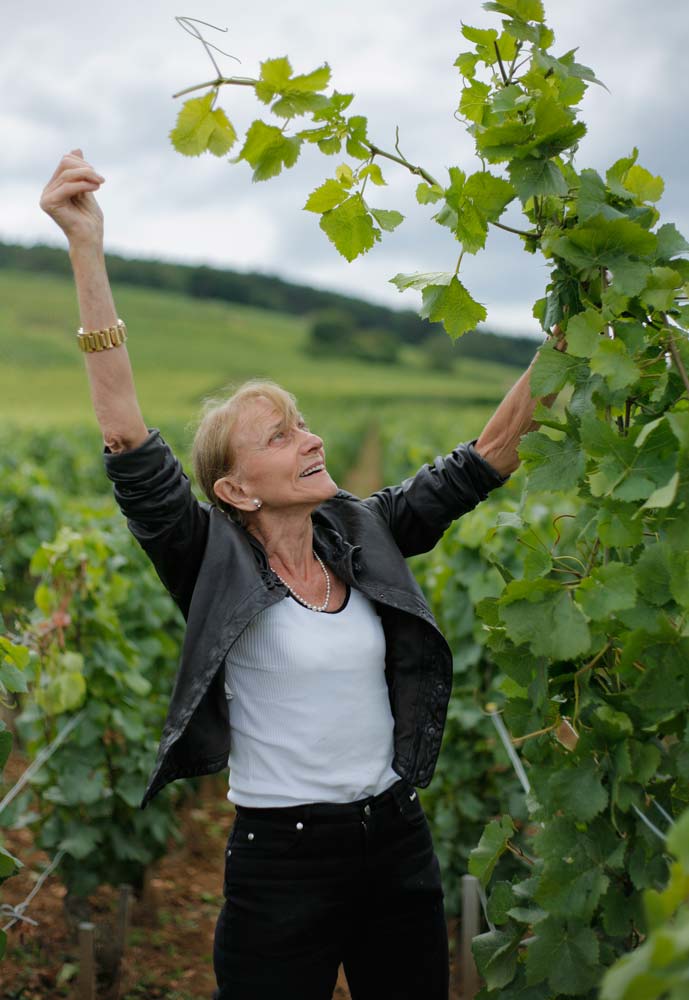
Richard has no certificate and does not want one, but the way he farms would satisfy most people who do. He gave up herbicides and insecticides back in 2011. The grass between the rows is whatever comes up on its own. And the same hands prune the same vines every year, because to his mind that is where the vintage is decided.
In the cellar
This is where the Guiborat style is really made. Richard blocks the malolactic, so nothing rounds off the edge the chalk gives the wine. Each parcel is kept apart and fermented in its own small tank. Oak barely features, just three foudres in the whole cellar. And the wines age slowly underground, in the family’s chalk cellar.

Place and terroir
The chalk that defines everything
Everything at Guiborat comes back to the chalk. Cramant sits on some of the purest in all of Champagne, and it was named Grand Cru in the very first ranking of the villages, back in 1911. The estate’s parcels are spread across four communes, each with its own soil and its own exposure, and each leaving a mark on the wine you can taste.

Mont-Aigu
Chouilly Grand Cru · south to south-east exposure · 47 ares, planted 1970
Les Caurés
Chouilly Grand Cru · north to north-west exposure · 2 hectares, planted 1946 to 2011
Les Bergeries
Cramant Grand Cru · flat, light north exposure · 40 ares, planted 1984
Gros Monts
Oiry Grand Cru · north exposure · 25 ares, planted 1969
Les Chataigniers and Les Carrés du Midi
Mardeuil, Vallée de la Marne · north exposure · Pinot Meunier, planted 1954 and 1960
The cuvées
Four expressions of one philosophy
Four wines from three and a half hectares, and what shapes them is mostly what Richard leaves out: the malolactic since 2006, and all but three grams of dosage.
GRAND CRU BLANC DE BLANCS
Téthys
VINEYARDS
Chouilly, Cramant and Oiry, selection shifting by year
DOSAGE
Under 3 g/L, full malolactic
AGEING
24–30 months before disgorgement
PRODUCTION
12,000–15,000 bottles
GRAND CRU BLANC DE BLANCS MILLÉSIMÉ
Prisme
VINEYARDS
Les Bergeries 1984 · Les Caurés 1946, 1998, 2005 · Mont-Aigu 1970 · Gros Monts 1969
DOSAGE
Under 3 g/L, no malolactic
AGEING
42–48 months before disgorgement
PRODUCTION
10,000 bottles and 500 magnums
GRAND CRU BLANC DE BLANCS MILLÉSIMÉ
De Caurés à Mont-Aigu
VINEYARDS
Les Caurés 1946 · Mont-Aigu 1970
DOSAGE
Under 3 g/L, no malolactic
AGEING
60–72 months before disgorgement
PRODUCTION
4,000 bottles
BLANC DE NOIRS MILLÉSIMÉ
Prohibition
VINEYARDS
Les Chataigniers 1954 · Les Carrés du Midi 1960
DOSAGE
Zero, no malolactic
AGEING
30–36 months before disgorgement
PRODUCTION
4,000 bottles
Critical reception
Tension, energy, pure chalk
The critics have been generous, and unusually of one mind about why. Galloni writes of wines that sizzle with tension. Decanter’s Tom Hewson calls them laser-bright. William Kelley points to the serious farming behind them. Essi Avellan names the house in the same breath as Egly-Ouriet and Ulysse Collin.
Serious farming, with cultivated soils and low yields, means that these are concentrated, incisive wines that require only modest dosage, and I was extremely impressed on this first visit. These are very serious wines that merit readers’ attention.
William Kelley · Wine Advocate · September 2021
By 2024 the notes had stopped sounding like discoveries and started sounding like assessments.
This fine grower estate in Cramant produces wines that buzz with the laser-bright energy and chalky purity of the northern Côte des Blancs, unmarked by either spicy oak or creamy malolactic fermentation.
Tom Hewson · Decanter · May 2024
This is a stellar set of new releases from Guiborat. The wines sizzle with tension. As good as the top wines are, the Téthys is one of the finest wines in its price range.
Antonio Galloni · Vinous · November 2025
A closer look
One of the twenty Champagnes of his life
Pol Roger 1921 ·
Bollinger R.D. 1959 ·
Krug 1961 ·
Lanson 1976 ·
Veuve Clicquot Rosé 1978 ·
Krug Clos du Mesnil 1979 ·
Dom Pérignon 1983 ·
Palmer & Co Blanc de Blancs 1985 ·
Charles Heidsieck Blanc des Millénaires 1985 ·
Salon 1985 ·
Pierre Moncuit Cuvée Nicole Moncuit 1988 ·
Egly-Ouriet Blanc de Noirs Grand Cru ·
Pommery Cuvée Louise 1990 ·
Laurent-Perrier Grand Siècle ·
William Deutz La Côte Glacière 2012 ·
Taittinger Comtes de Champagne 1995 ·
Jacquesson Aÿ Vauzelles Terme 1996 ·
Piper-Heidsieck Rare 1998 ·
Philipponnat Les Cintres 2008 ·
Guiborat, De Caurés à Mont-Aigu 2014
Late in his career Michel Bettane set down the twenty Champagnes that had moved him most across a lifetime of tasting. The last of them comes from Richard Fouquet’s three and a half hectares. How it got there is worth reading.
In person
Sometimes a wine finds you first
I did not go looking for these wines. A friend from my school days in Lyon put a glass in my hand at a farmhouse in Provence, eight days after my wedding, and I did not forget it, even though I could not find the wine anywhere in Britain for three years afterwards. When I finally drove out to meet Richard and Karine, a short visit turned into a memorable encounter.
My first visit to the domaine came in January 2026, a month after my son was born. I arrived an hour early by accident and spent that hour in the winery with Richard, talking about his vines, his grandmother’s cellar, and his conviction that terroir speaks most clearly when the winemaker steps back.
Three hours later they asked whether I had time for lunch. We went to the Café du Centre in Cramant, a small bistro full of regulars who all know one another, and I felt at home in Champagne for the first time.
It is a privilege to be the first to bring the Guiborat wines to the UK.
Corentin Margier


GET IN TOUCH
Talk to us about allocations, listings, or the wines themselves.
Trade
For sommeliers, restaurants,
hotels and merchants.
Allocations, pricing and
account opening.
About
Who’s behind Terroirs, and
how the portfolio is built.
Contact
Have a question?
We'd love to hear from you.
↑
☰