

Alvina Pernot
The village sits on a slope of just over two hundred hectares, and what is on it has been on it, in the same families, for generations. For a serious new domaine to take root here is rare. For one to do so with privileged access to some of the appellation’s most coveted parcels is rarer still.
At a glance
BASED IN
Puligny-Montrachet
Côte de Beaune, Burgundy
FIRST VINTAGE
2018
Eight cuvées, six thousand bottles
UNDER VINE
Just over three hectares
Under full management from 2025
FARMING
Organic in practice, uncertified
The right answer changes with the year
PRODUCTION
17,000 bottles
2025 vintage
UK
Exclusive to Terroirs
From the 2025 vintage
The story
One name on the label, two people behind it

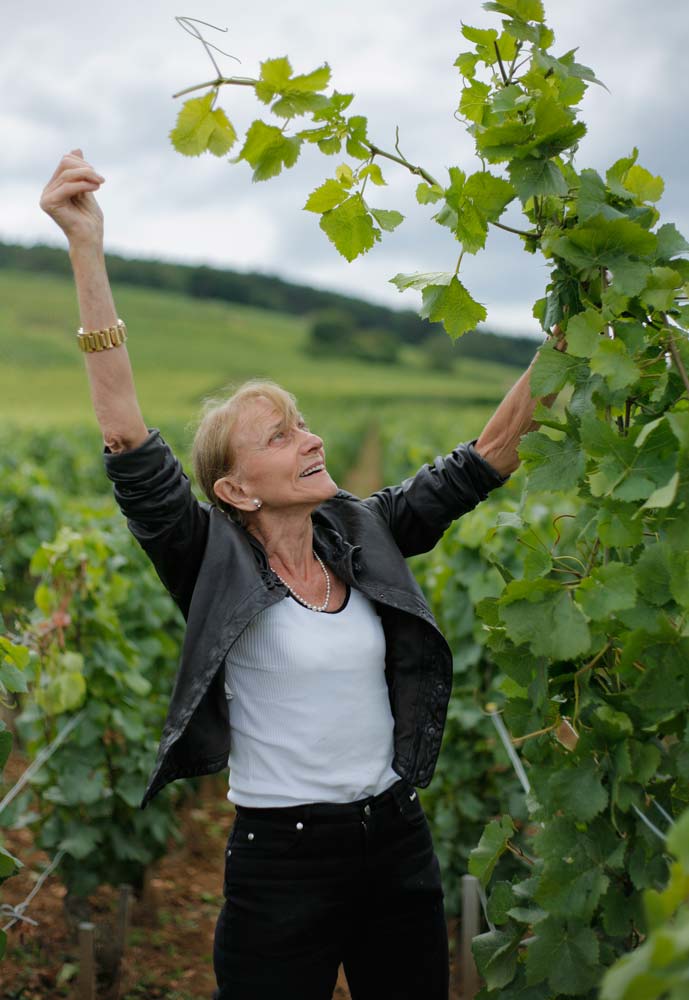
Alvina is the granddaughter of Paul Pernot, who has farmed in Puligny since 1955. The family is the second-largest holder of vines in the village after Domaine Leflaive, and the largest single owner of Les Folatières, including the walled Clos des Folatières monopole.
Philippe is the unusual ingredient. He did not grow up on a vineyard, though four generations of wine sit behind him, and he learned cellar work in shorter spells across several houses. He arrived with the technical confidence of someone who had watched many cellars, and the outsider’s freedom to ask why things were done the way they were. That second quality has mattered at least as much as the first.
The cellar runs on two pairs of hands, with the consulting eye of Pierre Fonteneau through the year. At the winery Alvina is the more reserved of the two, leaving the presenting to Philippe and often slipping in towards the end of a tasting. Where she is steady and quiet, he is the louder enthusiasm of the household.
“All we hope is that our wines might one day express the terroirs of Puligny with all the precision and purity they deserve.”
PHILIPPE ABADIE
Vineyard and cellar
The vineyard and the cellar are part of the same long sentence

There is no certification logo on the back label. Alvina and Philippe declined to file for organic or biodynamic certification from the founding vintage, on the grounds that the right answer changes with the year. In a forgiving season the work runs almost entirely organic, with copper and sulphur the only inputs the vines see, sometimes with as few as ten treatment passes across the year.
They pick consistently earlier than Domaine Paul Pernot, by three to five days on identically sited parcels, and have done so since the founding vintage. A late-picked Puligny tells you about ripeness. An early-picked one tells you about place.
Burgundy’s spring frosts are an annual gamble. A frost in mid to late April, after budbreak, puts the entire crop at risk, and the candles come out, lit precisely where the cold air pools. The work is done by hand, often in the small hours, the pale light of paraffin flames moving along the rows.
Fruit arrives in small wooden cases rather than bins, so the bunches travel intact and the juice does not begin to oxidise on the way to the press. Where the volume allows, pressing is done in a vertical press: a single, slow pressing under the weight of the press itself, with no rebêche and no remixing of the marc. The juice comes off clear enough that débourbage is skipped entirely, going from press to barrel without a settling step.
Fermentation is on native yeasts, with no pied de cuve and no commercial culture. Sulphur is held back, and in a vintage that allows it none is added at all between the press and the end of malolactic fermentation.
Bâtonnage is almost never done. Élevage runs from eleven months to a full twelve in Burgundian pièces, from two cooperages chosen for long, slow air-drying and very gentle toasting. New oak averages around twenty per cent across the range, closer to five on the regional cuvées and rising to a third on the Grand Crus.


The cuvées
Twenty minutes and a dozen parcels
The slope is gentle at the village edge and steepens sharply behind. The earliest plantings sit at the foot of the hill, while the most prized parcels are higher up, where the topsoils thin out and the morning sun finds them first. Plot sizes are given in ares; one hundred ares make a hectare.
Regional
Bourgogne Côte d'Or Rue de Bois
+
Bourgogne Côte d'Or Les Femelottes
+
Village
Puligny-Montrachet La Rue aux Vaches
+
Puligny-Montrachet Clos des Noyers Brets
+
Puligny-Montrachet Tremblots
+
Puligny-Montrachet Grands Champs
+
Puligny-Montrachet Enseignières
+
Puligny-Montrachet Rue Rousseau
+
Santenay Bievaux
Red
+
Premier Cru
Puligny-Montrachet 1er Cru Les Chalumaux
+
Puligny-Montrachet 1er Cru Clos de la Garenne
+
Puligny-Montrachet 1er Cru Clos de la Jacquelotte
+
Puligny-Montrachet 1er Cru Peux Bois
+
Puligny-Montrachet 1er Cru Clos des Folatières
Monopole
+
Puligny-Montrachet 1er Cru Les Caillerets
+
Puligny-Montrachet 1er Cru Les Pucelles
+
Meursault 1er Cru La Pièce sous le Bois
+
Meursault 1er Cru Les Poruzots
+
Grand Cru
Bienvenues-Bâtard-Montrachet
+
Bâtard-Montrachet
+
Chevalier-Montrachet
+
Corton-Charlemagne
+
Joining from the 2026 vintage: Puligny-Montrachet Le Trézin and Volnay 1er Cru Carelle sous la Chapelle. From 2027, Meursault Blagny 1er Cru La Pièce sous le Bois becomes a domaine plot, alongside Puligny-Montrachet 1er Cru Champ Canet and a new Bourgogne Côte d’Or, Les Petits Champ Canet.
Critical reception
What the critics have been watching
Seven vintages in bottle now, and the watching has turned into admiring. Allen Meadows saw the promise in the 2018 debut and has followed the wines ever since.
While it’s true that this new entry into the Puligny wine scene enjoys the inestimable benefits of having access to superb raw materials, Alvina and Philippe appear to already be making the most of it.
Allen Meadows · Burghound · 2018 vintage
In 2020 the fruit went through their own press for the first time. Kelley singled out exactly those cuvées.
Within the Pernot holdings, Alvina and her husband favour earlier-picked fruit and higher-altitude parcels, but it’s these cuvées that are harvested and pressed in-house that really give the measure of what we can expect in the years to come.
William Kelley · Wine Advocate · 2020 vintage
By 2022 their appearances in Meadows’ annual top thirty-five had started to climb: two, then five, then six. The verdict has since become unanimous.
Alvina Pernot and her husband Philippe are currently producing some of the best new whites in Burgundy.
Steen Ohman · Winehog · 2024 vintage
A closer look
Allen Meadows, the man who gives the little hearts
♥♥♥♥♥♥♥♥♥♥♥♥♥♥♥♥♥♥♥♥♥♥♥♥♥♥♥♥♥♥♥♥♥♥♥♥♥♥♥♥♥♥♥♥♥♥♥♥♥♥♥♥♥♥♡♡♡♡♡♡♡♡♡♡♡♡♡♡♡
Of the sixty-nine eligible Alvina Pernot wines he has tasted, he gave the heart to fifty-four. Close to eight in ten, from a domaine barely six vintages old.
Meadows reserves the mark for wines that stop him, and as a matter of policy never awards it to a Grand Cru. Thirteen of the eighty-two wines he has tasted here were therefore ineligible.
In person
A friendship before the wines
I am, of course, biased. I have known these wines from the very first barrel, and been lucky enough to call Alvina and Philippe friends for far longer.
Their first vintage was 2018, and the following summer they took us into the cellar beneath their house in Puligny. The ceiling was so low that Philippe, the tallest of us, was almost bending to reach the back rows of barrels. There were fifteen or twenty in total, neatly arranged along the gravel floor.
Several still bore the discreet logo of Domaine Henri Boillot, passed on as used barrels by Guillaume Boillot to spare a young domaine an entirely new-oak first vintage. Alvina and Philippe walked us through every cuvée. We tasted the lot, La Rue aux Vaches included. Eight cuvées, six thousand bottles, and the start of everything.
Terroirs


GET IN TOUCH
Talk to us about allocations, listings, or the wines themselves.
Trade
For sommeliers, restaurants,
hotels and merchants.
Allocations, pricing and
account opening.
About
Who’s behind Terroirs, and
how the portfolio is built.
Contact
Have a question?
We'd love to hear from you.
↑
☰