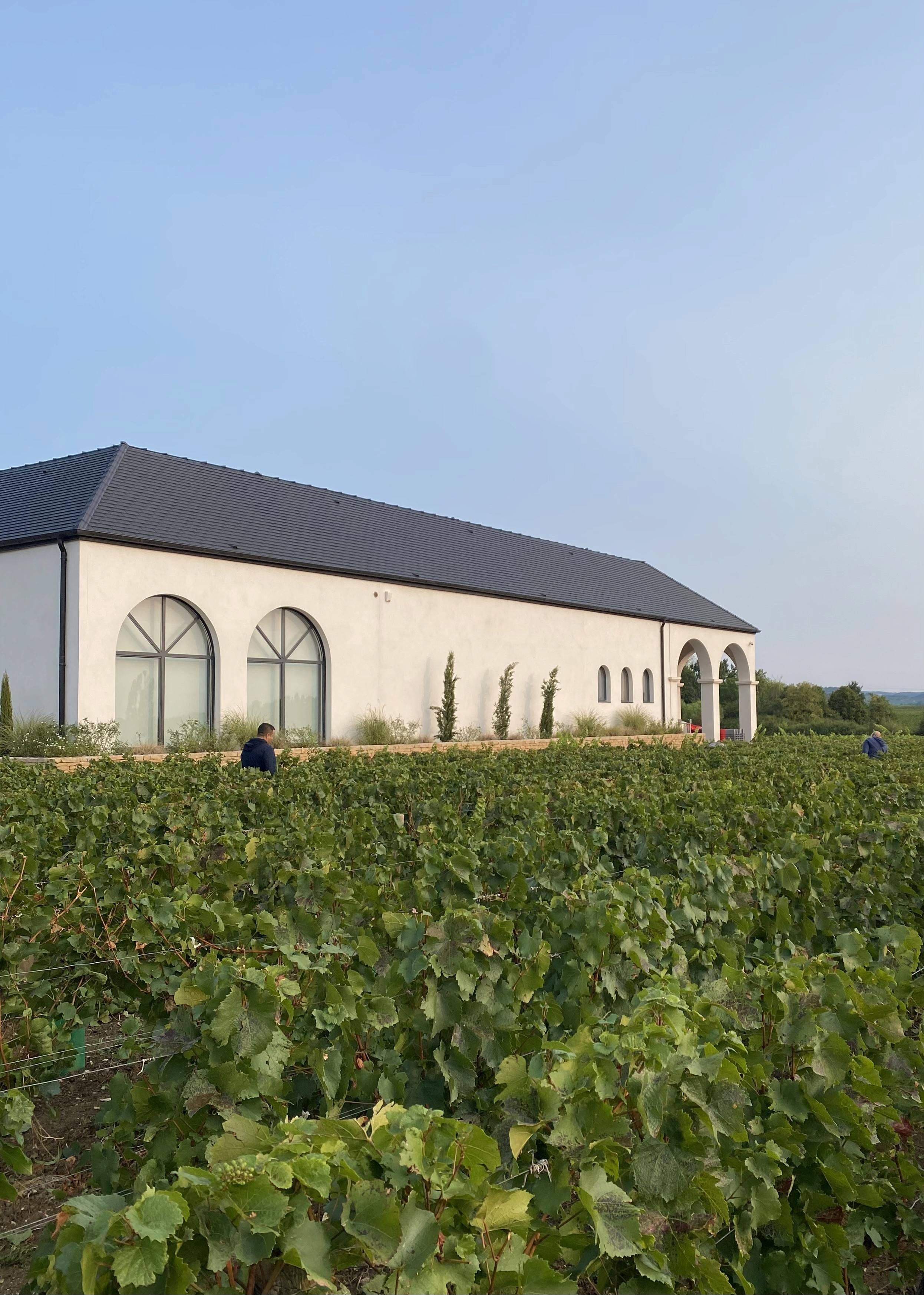
IN THE CELLAR
Letting Each Parcel Through
The cellar work at Domaine Alvina Pernot is an extension of the work in the vineyard. The ambition is to let the parcel come through as cleanly as the year allows. The decisions that follow are an exercise in restraint.
Pressing
Fruit arrives in small crates, so the bunches travel intact and the juice does not begin to oxidise on the way to the press. Where the volume from a parcel allows, pressing is done in a vertical press: a single, slow, gentle pressing under the weight of the press itself, with no rebêche and no remixing of the marc to extract the last drops. The horizontal pneumatic press, used on the larger parcels, is run with the same intent, taking only the cleanest juice from a soft cycle. In either case the result is a juice clear enough on its own that débourbage is skipped entirely. The juice goes from press to barrel without a settling step in between.
Less handling, less oxidation. Where grapes arrive a touch too warm from a late morning of picking, they spend a few hours in the cold room before pressing, so that the juice goes into barrel at the temperature the cellar has been set to hold.

Fermentation
Fermentation is on native yeasts. There is no pied de cuve and no commercial culture. Whatever the parcel and the year have produced is what enters the barrel. The cuverie is held cool through the harvest itself, at around ten degrees, while the barrel cellar is climate-regulated to twenty or twenty-one degrees through the ferments, which keeps the fermentation moving steadily without ever running hot, with barrel temperatures rarely climbing past twenty-three. Sulphur is held back. In a vintage that allows it, no SO₂ is added at all between the press and the end of malolactic fermentation. The wines are protected by their own freshness and by the tightness of the cellar’s discipline. A small dose goes in the moment malo is complete, and the timing matters: too late and the wines lose freshness and tension. Years of less generous fruit will sometimes need a small correction earlier. The principle is the same regardless: the less sulphur the wine carries through its early life, the better the wine speaks later on.
The cellar is held warm enough through the malos themselves, around seventeen or eighteen degrees, so that the conversion can complete cleanly through the winter. Once the last malos are done, the cellar is opened to the cold and allowed to drop to five degrees where the year permits, precipitating the tartaric naturally and giving the wines the stability they need without intervention.

Élevage
Bâtonnage is almost never done. The wines rest on their fine lees through the winter and into the following year, with minimal disturbance. The rare exception is a small pass on a barrel whose fermentation has slowed more than its neighbours, to put a little air back in and let the ferment finish; this is a working adjustment rather than a stylistic choice, and Alvina and Philippe would not call it bâtonnage themselves.
Élevage runs from eleven months to a full twelve, depending on the rhythm of the vintage, with the wines moving back into Burgundian pièces across the range. The oak comes from two cooperages chosen for the same qualities: long, slow air-drying of the staves, and very gentle toasting. Tonnellerie Rousseau in Burgundy is the historical partner; Stockinger in Austria has joined the rotation in 2024. New oak proportion averages around twenty per cent across the range as a whole, closer to five per cent on the regional cuvées, rising to a third on the Grand Crus, where the structure of the wine asks for a touch more support. Even at that ceiling, the toasting is gentle enough that the new oak doesn’t announce itself in the glass.
Terracotta amphorae are used selectively, in richer vintages where their slow exchange softens a young wine without taking from its line. In a cooler, more classical year, no amphora is used at all. The point of the élevage is to let the wine settle into itself, whatever it is held in.
Bottling
The wines are bottled towards the end of the summer, just before the next harvest. The closure is raw natural cork, hot-water cleaned and otherwise untreated. Filtration is done on a wide lenticular filter, set as open as the wine will tolerate, so that what reaches the bottle is still alive. There is no fining as a rule. On the rare occasions a wine shows protein instability that would cloud the glass, a light fining is done, and only then. The bottling itself is outsourced to a local contractor with mobile equipment, brought in for the few days the work takes each year.
From 2025 onwards, the closure receives an opercule over the cork with a small wax dot on top, replacing the older hand-poured wax method and giving the seal a cleaner, more even finish bottle to bottle.

Two Pairs of Hands
The cellar runs on two pairs of hands, Alvina’s and Philippe’s, with the consulting eye of Pierre Fonteneau on hand through the year. Pierre’s role was central in the early vintages, when the technical questions came thick and fast and a young domaine had to answer them one by one before they became instinct. As the years have passed, those answers have settled into practice, and Alvina and Philippe now turn to him for the occasional third palate on a wine they want to test themselves against, rather than for guidance on the day-to-day.
What they have built is a working method that lets two people, with one trusted voice in occasional support, look after twenty-two cuvées with the care that each parcel deserves.
The cellar is theirs, and so are the principles that run through it.
GET IN TOUCH
Talk to us about allocations, listings, or the wines themselves.
Trade
For sommeliers, restaurants,
hotels and merchants.
Allocations, pricing and
account opening.
About
Who’s behind Terroirs, and
how the portfolio is built.
Contact
Have a question?
We'd love to hear from you.
↑
☰