
THE CUVÉES & THEIR TERROIRS
A Slope, A Family, A Range
Puligny-Montrachet covers two hundred and twenty hectares, and walking through the village out into the vines, one can cross more named parcels in twenty minutes than make up some entire appellations. Each one has its own story, its own soil, its own claim to attention. The slope is gentle at the village edge and steepens sharply behind. The earliest plantings sit at the foot of the hill, while the most prized parcels are higher up, where the topsoils thin out and the morning sun finds them first. Across the upper-mid slope runs the band of Grands Crus. The Premiers Crus step above and below them, and below those again, the village lieux-dits hold their own territory: some of them have been bottled separately for a century, while others are only now stepping out from the blends they once disappeared into.
A medieval legend gives the village its tone. The Seigneur de Puligny, lord of the slope when most of these climats were first cleared, is said to have divided his estate among his children. To his eldest son, the Chevalier (the knight), he left the highest, finest land. To his daughters, the Pucelles (the maidens), he gave the parcels closest to the village, on heavy clay soils thought to mirror their grace. To his illegitimate son, the Bâtard, he conceded the foot of the slope, where the ground is deepest and hardest to work. And on the welcome path that ran between them, a small parcel kept the name Bienvenue. The story is part folklore, part etymology, but it has stuck for eight centuries. Walk the slope today and the family is still there, the same hill speaking in four voices a few hundred metres apart.
This is the range as it stands for the 2025 vintage, the vintage that marks a turning point for the domaine: just over three hectares of vines are now under Alvina and Philippe’s full management, and the line-up runs to twenty-two cuvées in total: twenty-one in white from Puligny and its immediate neighbours, and one in red from Santenay. Almost every wine is a single parcel, and the few exceptions come from must exchanges with trusted neighbours, kept in the range by choice.
A note on units: plot sizes are given throughout in ares (1 are = 100 m²; 100 ares = 1 hectare).
Bourgogne Côte d’Or

Two plots totalling 23.29 ares, planted 1999 and 2021. Domaine.
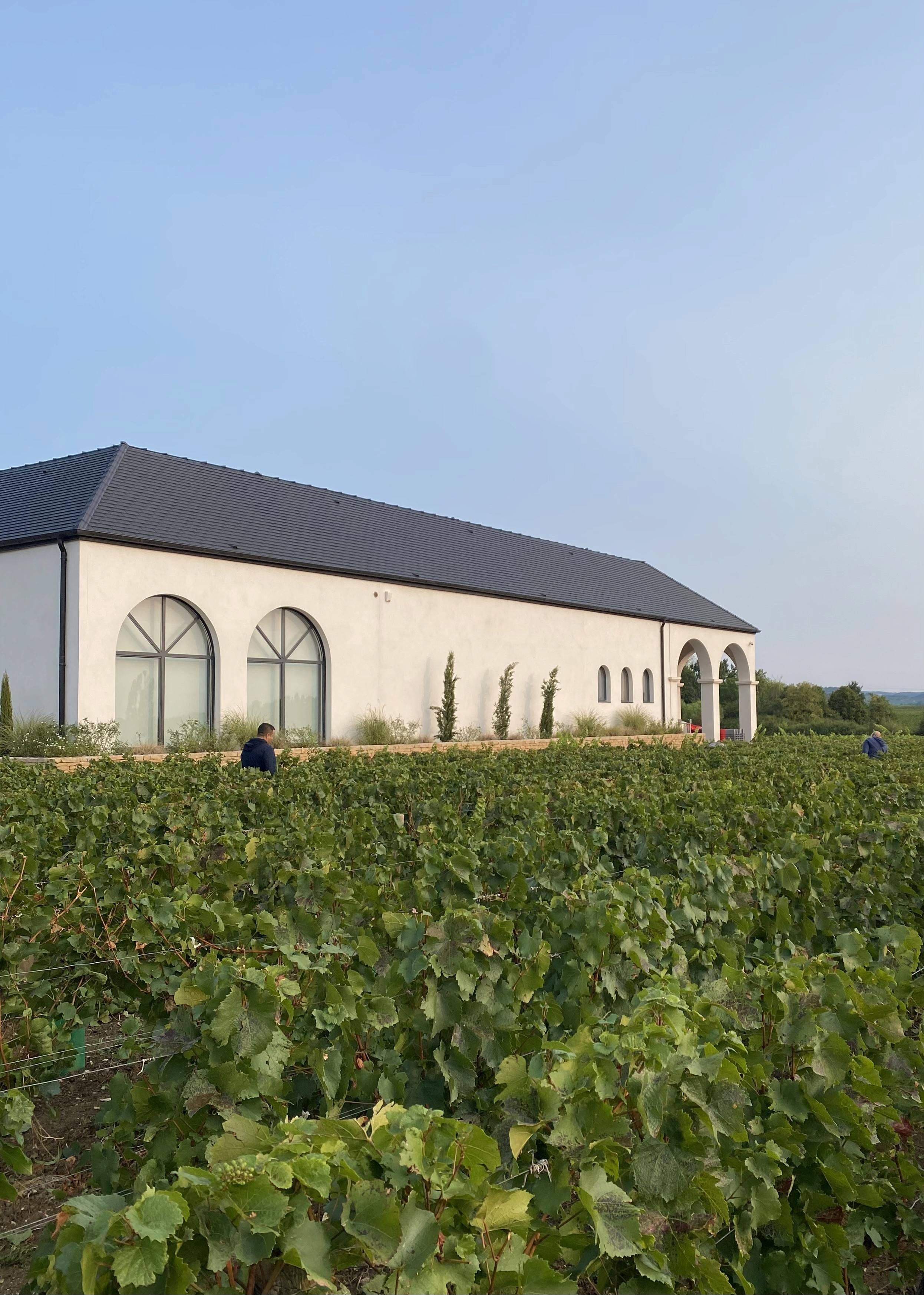
The vineyard wraps around the winery itself, on the gentle ground at the entrance of the village just below Le Clos du Château, the five-hectare walled vineyard in front of the Château de Puligny-Montrachet that Etienne de Montille kept for his own domaine when he sold the Château itself to François Pinault's Artémis. The new owner is currently building the cellars for Domaine des Cabottes there. Two plots of unequal age share the same soil and aspect: a mature parcel from 1999, and a younger one planted in 2021 as the winery was being built. A regional appellation that punches consistently above its level, and one that, served blind, can be hard to pick out from a Village wine.

Métayage from Alvina's uncle. 2025 is the last vintage.
A regional cuvée from a parcel adjacent to the Puligny appellation, with vines older than those of the Rue de Bois, picked later, and showing more breadth on the palate. The 2025 will be the last vintage under Alvina and Philippe's care, as the parcel passes back to her uncle's side of the family for the next generation.
Puligny-Montrachet - Village
One plot, 4.13 ares planted 2000. Domaine since 2018, the founding parcel.
The parcel that began everything. La Rue aux Vaches sits just below the Premiers Crus Clos des Meix and Les Pucelles, on a slope steep and well-drained enough to give the wine the structural credentials of a Premier Cru in all but classification. Bought together by Alvina and her father in 2017, it has been harvested and pressed in-house from the very first vintage. Production runs to a single barrel each year, and the wine is bottled exclusively in magnum, with the single exception of 2024, when a short Puligny village crop and a long list of clients meant a small quantity of standard bottles were released alongside.

One plot, 33.05 ares planted 1984. Domaine since 2020.
The parcel where the domaine grew up. It wraps around the house in Puligny that Alvina and Philippe lived in during the early years, and beneath which they aged their first three vintages in a small cellar. The vines were planted in 1984, on a sheltered village site just below the Enseignières lieu-dit. Stylistically, Noyers Brets sits on the more generous side of the village range: a wine that drinks well young, with broader shoulders than most Puligny villages. In richer vintages, the cuvée can include a portion of terracotta amphora in the élevage, as it did in 2023, though never as a fixed rule.


One plot, 35.17 ares planted 1977. Domaine since 2025.
The southernmost lieu-dit in the Puligny appellation, sitting flat against the Chassagne border on limestone-marl soils studded with white pebbles. The name probably derives from trembles, the aspen trees that once grew on the site. What gives Tremblots its character is its position: directly below Bâtard-Montrachet, on the same line of soil that runs from the Grands Crus down to the Chassagne edge. Olivier Lamy’s old-vine Tremblots, a wine of unusual depth and breadth for a Village cuvée, has been a long-standing favourite of ours, and Alvina and Philippe’s first version of this cru is one we are very much looking forward to tasting.

One plot, 21.68 ares planted 1959. Domaine since 2025.
A village lieu-dit on the lower part of the slope, just below Clavoillon. The vines were planted in 1959, among the oldest in the entire range. The parcel sits on a complex layering of soils, a clay-rich topsoil over gravelly limestone studied in detail by the geologist François Vannier-Petit, and it is the combination of mature roots and that layered profile that gives the wines a depth and freshness rarely found together at village level. One to watch closely over the coming decade.

One plot, 16.11 ares planted 1990. Domaine since 2025.
Probably the most coveted village lieu-dit in all of Puligny-Montrachet. Enseignières sits directly below Bienvenues-Bâtard-Montrachet, on the same line of soil as its illustrious neighbour, and the wines from it punch consistently at Premier Cru level. Coche-Dury and Domaine d’Auvenay both own vines here, and the visibility and reputation of the cru today owe them a great deal. Bottled by the domaine for the first time in 2025, this is one of the cuvées in the new range to look out for.

One plot, 12.12 ares planted 2000. Domaine since 2025.
Sitting just below Bienvenues-Bâtard-Montrachet and bordering Enseignières all along its northern side, Rue Rousseau may well turn out to be the best-kept secret of the range. The lieu-dit is little known, but the position and soils are difficult to argue with: the same line of land that gives Enseignières its quality runs straight through here. Bottled by the domaine for the first time in 2025.
Puligny-Montrachet - Premiers Crus

Family parcel, planted 1954 by Alvina’s grandfather Paul.
A Premier Cru on the upper part of the slope, neighbour to Champ-Canet and Combettes. The vines, planted by Paul Pernot in 1954, sit on a thin layer of soil only ten centimetres or so above the underlying limestone, which forces the roots straight down into the rock. The wine is taut and stony, and especially well suited to the cooler, wetter vintages where the natural drainage of the site comes into its own.

Family parcel acquired by Alvina’s great-grandfather. Replanted 1957. Shared exclusively with the Duc de Magenta.
A historic family parcel of around 0.7 hectares, replanted in 1957. The vineyard is enclosed by woodland on three sides (garenne meaning rabbit warren) and sits between the Pernot family’s Jacquelotte parcels above and Henri Boillot’s Clos de la Mouchère below. The protective wood draws cooler air from the north into the parcel and gives it slightly richer soils than the Premier Crus around it, which has historically allowed the cuvée to perform well in warmer vintages. Only two domaines bottle from this lieu-dit: Pernot, and the Duc de Magenta. The Garenne will eventually leave the range, having gone to Alvina’s uncle in the family inheritance.

Family parcel, planted 1966. The 2025 vintage is the last under their care.
A lieu-dit within the Premier Cru Champ-Canet, near the top of the slope, with only two owners across the entire appellation: Pernot, and Jacques Carillon, who bottles his portion as Champ-Canet. The 2025 will be the last vintage under Alvina and Philippe’s care, as the parcel returns to the wider family for the next generation.

Lieu-dit at the upper edge of Folatières. Family parcel.
A lieu-dit at the upper edge of Folatières, sitting on the same level as Chevalier-Montrachet and bordering directly En la Richarde to the north. The position is high on the slope, with thin soils and a cooler exposure than the rest of Folatières, the kind of conditions that bring out the precision and lift the family looks for from this part of the appellation. Bottled separately for the first time in 2022.

The walled monopole inside Folatières. Family parcel of approximately 1 hectare. Declared as a monopole for the first time in 2025.
The 2025 vintage is the first in which the Clos des Folatières is declared as a monopole of the family, and the parcel is set, in the years ahead, to pass to Alvina and become one of the flagships of the domaine. Folatières itself is the largest and most celebrated Premier Cru of Puligny, a long sweep of slope between Clavoillon and Champ-Gain, whose name is said to come from folles terres, the mad lands, in reference either to the landslides the slope has known or to the work involved in keeping the vines on it. The Clos sits apart from the main body of the cru, separated from the steep upper face by a small wood that shelters the parcel on one side, while on the other it rests just above Clavoillon, directly across the road from it. This puts the Clos at the same altitude as Caillerets and Le Montrachet, on the same vein of soil that runs across the foot of the slope, while the rest of Folatières climbs higher up the hill. The wood acts as a buffer in three directions at once: shelter from the worst of the afternoon sun in hot vintages, protection from the soils that wash down from the steep face above in heavy rain, and a steady presence of moisture in the parcel itself. Here the land is flat rather than steep, the vines are planted north-to-south rather than along the slope, and the water table sits closer to the surface than anywhere else in the climat. The result is a wine of structural confidence and depth, on what Philippe describes as the most harmonious site the family farms.


Échange de moût with a Puligny grower since 2019.
Caillerets sits on the same line of slope as Le Montrachet, immediately to the north, sharing the calcareous, stony character of the Grand Cru above and channelling it into a Premier Cru of remarkable cut and clarity. The name comes from an older form of caille, the Burgundian for stone, and the parcel is unmistakably stony: the wines from it are among Puligny’s most chiselled and mineral, the natural counterpoint to the more opulent Pucelles. As Philippe puts it, Caillerets is the baby Chevalier-Montrachet, while Pucelles is the baby Bâtard-Montrachet. Caillerets and Chevalier come from the same Puligny grower, who picks earlier than Domaine Paul Pernot and works to an approach close to Alvina and Philippe’s. The exchange is one of the few that will remain in the range for the foreseeable future, kept because both sides love the style of the terroir and the harvest discipline of the grower.

One plot, 9.05 ares planted 1961. Domaine since 2025.
Pucelles sits on the Premier Cru band at the same level as Bienvenues-Bâtard-Montrachet and Bâtard-Montrachet, just upslope from the village, on heavy clay soils that give the wine its concentration and depth. Long held to be the most powerful and opulent of the Puligny Premier Crus, the natural counterpoint to the more linear Caillerets across the road. The domaine’s parcel sits centrally within the climat, just below Caillerets, while Domaine Paul Pernot retains its own parcel further over, closer to Bienvenues. The two wines, although from the same climat, sit on different lines of soil within it: the Pernot parcel a little heavier and richer, while Alvina’s central plot tends slightly more towards lift and tension. Until this vintage, Alvina’s Pucelles was made from a combination of family fruit and an échange de moût; from 2025, the cuvée comes entirely from a single 64-year-old plot under her and Philippe’s full management, a meaningful step forward for one of the wines in the range that has always rewarded a few extra years in bottle.
Meursault - Premiers Crus

Family parcel of approximately 1 hectare on the Blagny plateau. Re-grafted to Chardonnay in the early 2000s.
The name, as so often in Burgundy, tells you exactly where you are: la pièce sous le bois means the plot beneath the wood, and that wood is what defines the parcel. A line of forest sits directly above the vineyard, sheltering it from wind and warming sun alike, and the result is one of the latest-ripening terroirs in the wider Meursault appellation. Technically a Meursault Premier Cru, the parcel in fact lies within the boundaries of Blagny, on the high ground that separates Meursault from Puligny. It was originally planted to Pinot Noir, then re-grafted to Chardonnay in the early 2000s, and the wine is labelled under the lieu-dit name rather than as Meursault-Blagny. This is an administrative quirk that says nothing about the wine itself, which has the floral lift of high-altitude Chardonnay and a saline finish.


Échange de moût with a Meursault grower.
A Meursault Premier Cru retained in 2025 from an échange de moût, with fruit drawn from the lower part of the climat, towards Genevrières. Poruzots sits on the upper-mid slope of Meursault, with the heavier, broader build the appellation is known for: fuller-bodied than a Puligny of similar tier, with the white-fleshed orchard fruit and toasted-almond depth that defines the village. This is one of the cuvées likely to disappear from the range in the years ahead, as Alvina and Philippe focus the domaine more tightly around Puligny.
Grands Crus

Two plots, 14.62 ares total. 9.98 ares planted 1991, 4.64 ares planted 1967. Domaine since 2025.
The Grand Cru that Alvina and Philippe believe will respond most to their work. Bienvenues sits at the northeastern corner of Bâtard-Montrachet, on land slightly richer and deeper than the Bâtard above it, with a higher proportion of clay. The wines from it have always been distinguished by a balance of finesse and drive, an elegance that runs ahead of any pursuit of power. The smaller of the two plots was planted in 1967, on roots almost sixty years old, and the couple’s tension-first style is built to embrace the kind of fruit those vines produce. They are also clear-eyed about something else: in their view, Bienvenues was the most overlooked of the family’s Grands Crus during the years it was farmed by Paul Pernot, and the parcel they have inherited is the one in which they see the most untapped potential. It is, in their own words, the cuvée they intend to bichonner, the French verb both Alvina and Philippe use with affection, meaning to look after with close, careful, almost doting attention.

Two plots, 16.87 ares total. 11.15 ares in Chassagne planted 2017, 5.72 ares in Puligny planted 1991. Domaine since 2025.
Bâtard-Montrachet sits at the foot of the Montrachet slope, on the deepest and most clay-rich soils of the Pernot holdings, a mix of roughly fifty per cent clay to fifty per cent pebbles. The wine is the richest and most powerful of the Montrachet family, a Grand Cru of grandeur and sweep. Alvina and Philippe now make their Bâtard from two plots under their full management: a five-and-a-half-are parcel on the Puligny side, planted in 1991, and an eleven-are parcel on the Chassagne side, planted in 2017. The contrast gives the wine its structure: depth from the older Puligny roots, lift and clarity from the younger Chassagne ones.

Échange de moût. First produced 2020. No 2021 (frost).
The highest of the Montrachet Grands Crus, sitting directly above Le Montrachet on shallow, stony soils that force the vines deep into the rock for water, with a mix of around twenty per cent clay to eighty per cent pebbles. Chevalier produces the most precise and elegant wines of the Montrachet family, less rich than Bâtard, more linear, with a pure mineral cut. The Pernot family does not own land here, so Alvina and Philippe receive their Chevalier as must, exchanged with the same Puligny grower as their Caillerets, who picks early and works to a style close to theirs. The cuvée was first produced in 2020, and the 2021 was lost to frost.

Échange de moût with a Pernand-Vergelesses grower since 2019.
A Grand Cru from the great limestone hill of Corton, above the village of Pernand-Vergelesses on the Côte de Beaune. The Pernand side, where Alvina’s exchange comes from, is the cooler and steelier face of the appellation, later-ripening and more austere, with more citrus and chalk than the richer Aloxe side. Their grower there tends to pick early, in a style close to Alvina and Philippe’s. The choice of Pernand over Aloxe is a deliberate one, and the relationship is a long-term one. This is a cuvée that will continue in the range for the foreseeable future, anchored in real affection for the cru and for the grower who supplies them. Aged exclusively in used barrels, never in new oak.
Santenay

One plot, 26.45 ares planted 1979. Domaine since 2024, the 2025 vintage being the cuvée's first real success under their full management.
The single red in the range, and the cuvée Alvina and Philippe are most excited about heading into the new vintage. The parcel of forty-five-year-old Pinot Noir was reclaimed at the end of 2024. They were not satisfied with the result that year and chose not to bottle the wine, but the lessons they took from it shaped everything that followed. The 2025 has produced two barrels of the wine they have been aiming for from the start: fine, balanced, light on its feet, with crunchy fruit that is approachable immediately. Santenay is not an easy terroir, but it suits the style they want for their reds. As Philippe puts it, the goal is fin et équilibré, and the 2025 is the first vintage that gets there.

A final note on parcels not bottled separately. The domaine also farms a 13.45-are plot of village Puligny Paupillot, taken on in 2025 and used for must exchanges rather than for a separate cuvée. From the 2026 vintage onwards, a new 17.57-are parcel of Le Trézin will join the range as the vines come of age. Trézin sits at the very top of the village slope, between 350 and 400 metres of altitude, the highest vines in the appellation, on a cool, late-ripening exposure. As the climate continues to warm, parcels at this elevation are the ones to watch. Looking further ahead, a Volnay 1er Cru Carelle sous la Chapelle is also expected to enter the range from 2026, expanding their red programme alongside the Santenay Bievaux. From 2027, Meursault Blagny 1er Cru La Pièce sous le Bois becomes a domaine plot, alongside Puligny-Montrachet 1er Cru Champ Canet and a new Bourgogne Côte d’Or, Les Petits Champ Canet.
GET IN TOUCH
Talk to us about allocations, listings, or the wines themselves.
Trade
For sommeliers, restaurants,
hotels and merchants.
Allocations, pricing and
account opening.
About
Who’s behind Terroirs, and
how the portfolio is built.
Contact
Have a question?
We'd love to hear from you.
↑
☰