
The story
THE STORY
A family, a house, a vision
The story begins in Auxey-Duresses in 1868. François Leroy had been a vigneron since the 1840s, with vines in Auxey, Meursault, Pommard, Chambertin, Musigny, Clos Vougeot and Richebourg, and he had been selling his wines for twenty years through a commission agent at the Comptoir des Propriétaires de la Côte-d’Or in Beaune. In 1868 he decided to sell them himself, set up a négoce in the village, and called it Maison Leroy. His son Joseph extended the business into spirits and won medals at the great fairs of Europe. By the time Joseph’s son Henri joined the firm in 1919, the Maison had a cellar, a reputation, and an ambition that exceeded its size.
It was Henri who turned the Leroy name into something more than a négoce. He built up the cognac and brandy operations until the spirits side was generating more revenue than the wine, and he formed a friendship with Edmond Gaudin de Villaine, then gérant of Domaine de la Romanée-Conti through his first wife Marie-Dominique Chambon, that would shape the rest of his life. Marie-Dominique and her brother Jacques Chambon had become the sole owners of the estate on 23 October 1912. Henri came to know the domaine intimately and he understood its troubles. By the late 1930s, with war approaching and the family finances in difficulty, Jacques Chambon decided he had to sell his half of the shares. The risk was real that Romanée-Conti would be broken up among outside buyers. In 1942 Henri bought Chambon’s share himself, paying a sum that was, at the time, eye-watering, and made his friend Edmond a promise that Madame Bize-Leroy still likes to quote today: « Ne vendez pas vos parts, restez, vous verrez, nous en ferons un joyau. » Don’t sell your shares, stay, you will see, we will make this a jewel. Henri kept his word. He gave the next forty years of his life to Romanée-Conti, and by the time he died in 1980, the promise had long since been honoured.

Henri and his wife Simone had two daughters: Pauline, born in 1929, and Marcelle, born in Paris in 1932 and known to everyone as Madame Bize-Leroy. The family had moved by then from Auxey to the larger village of Meursault, and it was in Meursault that Madame Bize-Leroy grew up.
« Je ne suis pas un champion, je suis une apprentie, plutôt studieuse, très studieuse même. Et chaque année j’apprends quelque chose. »
I am not a champion, she still says today, I am an apprentice, a studious one, very studious in fact. Each year I learn something. The apprenticeship began in childhood. The family story is that Henri touched her lips with a drop of Musigny on the day she was born. She has told the story herself of the lunchtimes when, as a small girl, she would wait for her parents to retire to the drawing room so that she could slip back into the dining room and finish the glasses they had left behind. She took days off school during harvest to be in the cellars at Auxey. She rode with her father on his weekly drives up to Vosne-Romanée. She tasted from the casks at Romanée-Conti from the time she was small enough to need help reaching them. Henri was teaching her without saying he was teaching her, and the great vintages of the forties, fifties and sixties were what she learned on.


In 1955, when she was twenty-three, Henri put her at the head of Maison Leroy. He was giving more and more of his time to Romanée-Conti and to the brandy business in the Charente, and the négoce needed someone who would do the buying properly. She asked for a free hand and was given it. There was a life in the mountains open to her at the time, and she turned away from it.
« Je voulais faire de grands vins »
I wanted to make fine wines, she has said since. She went down into the cellars, came in at eight in the morning, did not come out until six in the evening, and tasted, in her own count, a hundred wines a day. The men around her in the Burgundian trade did not particularly care for the arrangement. They learned to live with it. By 1971 she was Présidente-Directrice Générale of the Maison, and in 1964 the house had been entrusted with the worldwide distribution of Romanée-Conti, with the United Kingdom and the United States carved out for separate importers. She had now become the public face of two of the most famous addresses in Burgundy, but the two were not one thing. DRC was a partnership in which she had no free hand. Maison Leroy was hers. She has always made the distinction herself, and she has always cared about the Maison with a particular fierceness, because it was the place where her own taste set the standard.
She met Marcel Bize in 1956, and they were married two years later. He was Swiss, eight years her senior, a former ski champion and a serious rock climber, and calm where she was fiery. Madame Bize-Leroy had been climbing herself since her twenties, and the marriage took her up the mountains it could not have taken her up alone. They climbed together. They skied together. They were inseparable, in her own words, from the day they met. Marcel did not work in wine, but he was on the board of Leroy SA, he travelled with her on every trip that mattered, and he defended her openly through the years that needed defending. She called him Pachou. Their daughter Perrine was born in 1959. The marriage lasted forty-six years, until Marcel was diagnosed with pancreatic cancer and died in a Monaco hospital in 2004 at the age of eighty. « Un être de lumière, » she said of him afterwards. A man of light. When the 2004 vintage came to be tasted the following year, Madame Bize-Leroy could not find in her own wines the standard she expected of them. She later told Allen Meadows of Burghound, who has been visiting her at the domaine every year since 1995, that after Marcel’s death she had become seriously depressed and had been unable to take her usual interest in the wines, and that the team, however capable, could not on its own hold them to the standard her clients deserved. She declassified the entire red range. Eight Grand Crus, eight Premier Crus, and eight Village wines came out as a small handful of Village bottlings and a Bourgogne Rouge. The act was unprecedented at this level of Burgundy, and it remains one of the most extraordinary gestures in the modern history of the region.


From 1966 onwards, while Perrine was still a small child, Madame Bize-Leroy had begun to host tastings at d’Auvenay, the old farmhouse high in the hills above Saint-Romain that would later become her home. The guests she invited were not buyers or brokers. They were the people who were then shaping how France was eating and reading about food. Paul Bocuse came down from Collonges. Jean and Pierre Troisgros came up from Roanne. Jacques Puisais, then president of the Union des Œnologues de France, was a regular at the table. Jean Lenoir, who would later create Le Nez du Vin, called the Leroy cellars « une Bibliothèque Nationale de la vigne. » The tastings continued for decades, and the dogs that have always sat at her feet through her working day were there for all of them.
In 1974, after Henri’s slow withdrawal, Madame Bize-Leroy took up the co-direction of Romanée-Conti alongside Aubert de Villaine. She was responsible for the commercial side. The eighteen years they worked together brought the domaine through some of its hardest passages, but the partnership was uneven from the start. Aubert had written privately to his father in 1970 that he did not believe in the work; Lalou, who did believe in it, carried the commercial side for both of them. Their fathers had been at odds about the quality of the wines for years, and the disagreement was beginning to surface between the children. What came of it is set out in A closer look. She was also, in those same years, watching Burgundy change in ways that she did not welcome. Growers were increasingly bottling their own wines. The number of cuvées available to a merchant of her standards was shrinking year on year. And the wines themselves, in her judgement, were not what they had been. Yields were rising. The vines were being driven harder. The synthetic chemistry that had arrived in the vineyards in the mid-sixties had, by the late seventies, become standard practice across the Côte. Each year she tasted fewer wines she could put under the Leroy label and more wines that she felt were watered-down versions of what she had known as a child.
The change came through Marcel. He brought home one evening an article from the Tribune de Genève about a Loire vigneron called Nicolas Joly, who had stopped using synthetic chemistry on his vines and was farming by the method set down by Rudolf Steiner in the 1920s. Madame Bize-Leroy read it and drove down to Savennières to see for herself. She walked Joly’s vines with him at La Coulée de Serrant. Joly remembers being surprised by her visit, and by the speed with which she understood: « Elle n’était pas venue pour apprendre, elle était venue par ouï-dire. Mais elle a compris. » She had not come to learn, she had come on hearsay. But she understood.
She returned to Burgundy, sought out François Bouchet, then the leading biodynamic consultant in France, and resolved to convert her vines as soon as she could.
She has said many times since, to Allen Meadows and to others, that the increasingly fine quality of her tannins owes itself to the deeper rooting that biodynamic farming requires of the vine.
The chance to do it at scale came soon afterwards. In 1988, the Charles Noëllat estate in Vosne-Romanée came on the market: twelve hectares of magnificently placed vineyards, with a list of Grand Cru holdings that almost never change hands. The Philippe Rémy estate in Gevrey-Chambertin would follow the year after. Madame Bize-Leroy wanted both. She did not, at the moment of deciding, have the means to pay for either, and worked it out by selling a one-third stake in Maison Leroy to her oldest Japanese importer, the Tokyo department store Takashimaya. She bought Noëllat, then Rémy, then a sweep of further parcels including Corton-Charlemagne, Corton-Renardes, Musigny, and Chambolle-Musigny Les Charmes. The total came to twenty-one hectares, ninety-nine ares and sixty-six centiares. The new estate was called Domaine Leroy, and from September 1988 every vine she owned on it was farmed biodynamically.
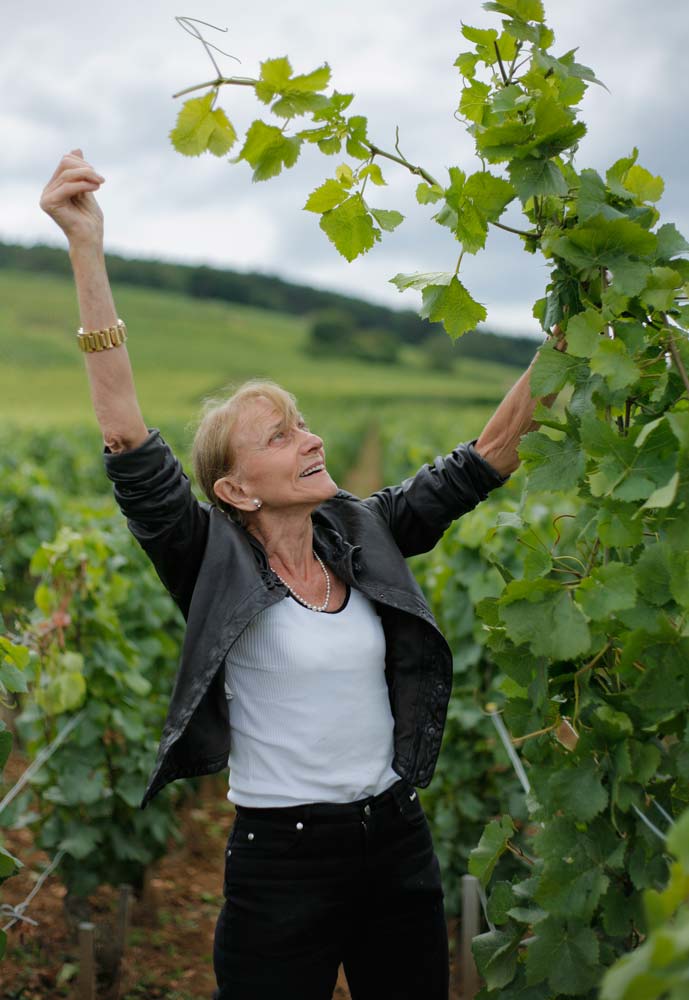

A year later, in 1989, she released the first vintage of a second estate. Domaine d’Auvenay was the smaller and more personal project, named for the old farm above Saint-Romain that had been in the family for two generations. Madame Bize-Leroy began assembling, parcel by parcel, a tiny holding now standing at under four hectares but containing Chevalier-Montrachet, Criots-Bâtard-Montrachet, Bonnes-Mares and Mazis-Chambertin. One of those first parcels was the family’s own Auxey-Duresses Les Clous, which the Maison had bottled in red for generations. She pulled out the Pinot Noir and replanted in Chardonnay. The decision made sense at the time, in the early years of d’Auvenay, when the project was conceived as a white-wine estate. She has said since that she regrets it. The vines, she remembers, had made beautiful wine.
In January 1992 came the rupture with Romanée-Conti. The official record is that Madame Bize-Leroy was removed from the co-direction over a disagreement about how the wines were being distributed in the United States and Japan. Maison Leroy lost the distribution of the Romanée-Conti wines at the same time, an agency it had held since 1964 and by far the largest the négoce carried. She kept her family’s quarter share of the estate, and keeps it still. The fuller story, which played out in print over the years that followed, is set out in A closer look. What it meant in practice was simpler. From that point onward, with the Maison standing at Auxey-Duresses and the Domaine and d’Auvenay each finding their feet, she had three businesses to run and the whole of her working life to give them. She gave it, and the wines came.
For all the scale of the undertaking, Domaine Leroy is run by a small group of people around one woman. Nothing at Leroy is decided by committee. What gets bottled, what is released and when, is Madame Bize-Leroy’s call and hers alone, and she has not delegated a piece of it.
Madame Bize-Leroy is in charge of everything that matters, and she still tastes every wine and decides what is released and when. She has lost a number of long-serving people in recent years, and the circle around her is closer-knit than ever. At the centre of it, alongside her, is Gilles Desprez, who came to the domaine after a career in some of the finest dining rooms in France, the United States and the United Kingdom. Gilles is the personne de confiance: the one who holds the practical life of the estate together, who knows where every parcel and every barrel and every case stands, and who carries the domaine in the wider world with a discretion and a courtesy that are increasingly rare. He is not a man who would ever put himself forward or claim to speak for Madame, and that is precisely why he is trusted as he is.
In July 2026 the Michelin Guide published its first ranking of Burgundy estates, the Grappes. Sixty-two domaines were selected across four tiers, and nine were given three grappes, the highest mark. Two of the nine were hers: Domaine Leroy and Domaine d’Auvenay, named alongside Romanée-Conti, Roumier, Coche-Dury, Dugat-Py, Hubert Lamy, Bouley and Cécile Tremblay. She was ninety-four, and still at her post every morning.

GET IN TOUCH
Talk to us about allocations, listings, or the wines themselves.
Trade
For sommeliers, restaurants,
hotels and merchants.
Allocations, pricing and
account opening.
About
Who’s behind Terroirs, and
how the portfolio is built.
Contact
Have a question?
We'd love to hear from you.
↑
☰