
In the vineyard
IN THE VINEYARD
The most exacting viticulture in Burgundy
Everything at Domaine Leroy begins in the vineyard, and everything in the vineyard begins with the conviction that quality is a question of yield.
« La qualité, c’est les rendements »
Madame Bize-Leroy means it more literally than almost anyone else in Burgundy is willing to. Where the appellation rules permit a grower to crop a Grand Cru at thirty-five hectolitres per hectare, Domaine Leroy comes in at half of that or less.

The 2002 vintage was made at 15.6 hectolitres per hectare across the estate. The 2005s were brought in at 15. The 2008s, a vintage she particularly loves, came in at 13. The 2010 crop was so small that the cellar looked half empty, and the 2016, hit by frost in the spring, fell to a single-figure average. The year that tested the principle hardest was 1993, when mildew ran through the Côte. Madame Bize-Leroy has explained since that clay had blocked the nozzles of her sprayer, so the copper and sulphur never reached the leaves as they should have. Between one Tuesday and the Thursday following, the disease went through her vines at Vosne-Romanée and Nuits-Saint-Georges. She did not turn to the synthetic treatments that would have stopped it, then or afterwards. From a hectare of Romanée-Saint-Vivant she made seven hundred litres.
That principle is biodynamics, adopted across every parcel from the founding of the domaine in September 1988, with no transition period. The vines are farmed by the calendar of Rudolf Steiner and Maria Thun, the soils worked by horse and by a fleet of deliberately lightweight Caval tractors that do not compact the ground. Maria Thun’s cowdung compost goes onto every parcel through the season, and the biodynamic preparations 500 and 501 are applied in their proper rhythm: 500 to the soil, drawing the roots deeper, encouraging the mycorrhizal networks that link the vine to its mother rock; 501 to the canopy, helping the leaves catch the light and turn it into the fruit. The domaine has never used herbicide, pesticide or synthetic fertiliser on a single row. Madame Bize-Leroy was among the very first in Burgundy to farm this way, at a time when her neighbours thought she had lost her mind, and the soils of the old Charles Noëllat vineyards, exhausted by decades of chemical farming when she bought them, have rebuilt themselves, in the years since, into some of the most alive land on the Côte.
Pruning
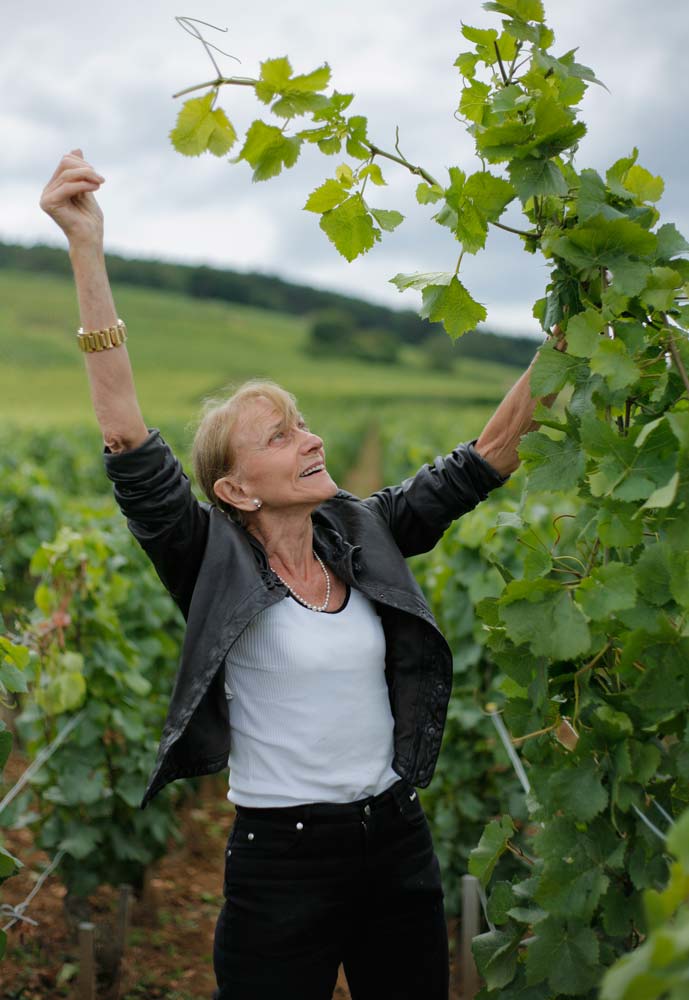
The pruning is severe and particular. The vines are pruned short, by Guyot simple, only on days the moon passes through the constellations of Sagittarius, Aries and Leo, with each pruning wound sealed by hand with a biodynamic paste. From 1999 Madame Bize-Leroy stopped hedging the vines in summer, a practice known as tressage, braiding, training the canopy upward and tying the long shoots back on themselves rather than cutting the growing tips. She believes that cutting the tip of the vine in summer stresses the plant and damages the following year’s flowering, and so the Leroy vines, left to grow tall and then folded back, are recognisable from across a vineyard. The crop is held down in spring rather than corrected in summer. The vines are debudded hard as the shoots appear, so that no bunch is ever set that will later have to be dropped on the ground. She will not have the leaves stripped from around the fruit, whatever the fashion elsewhere on the Côte, believing that a vine cannot carry too many of them and that the fruit ripens better in their shade. The trellising wires have been raised over the years, and the vines now stand well above her neighbours’. In the detailed work of the pruning itself she has long collaborated with Marco Simonit, the Italian master pruner, whose method makes smaller cuts on one side of the branch only, leaving a margin of protective wood and preserving the channels through which the sap rises, so that the vine stays healthy and lives far longer. The thinking sits naturally alongside Madame Bize-Leroy’s own, on an estate built around old vines.
There is no uprooting and no replanting at Domaine Leroy. Each vine that fails is replaced individually, by sélection massale from the domaine’s own stock, on the principle that a vineyard should be « comme un village » where the very young, the young, the adult and the old grow up together. Simonit now advises Latour, d’Yquem and Leflaive, and the years he has spent in the Leroy vineyards are no small part of why. The canopy work has travelled too, and Arnaud Mortet, Vincent Dureuil, Cécile Tremblay and Charles Lachaux now train their vines the same way. The work is enormously labour-intensive and requires a large permanent team. Most of her neighbours, even those who have come round to admiring the results, have looked at the running costs and decided they cannot follow her.
Harvest
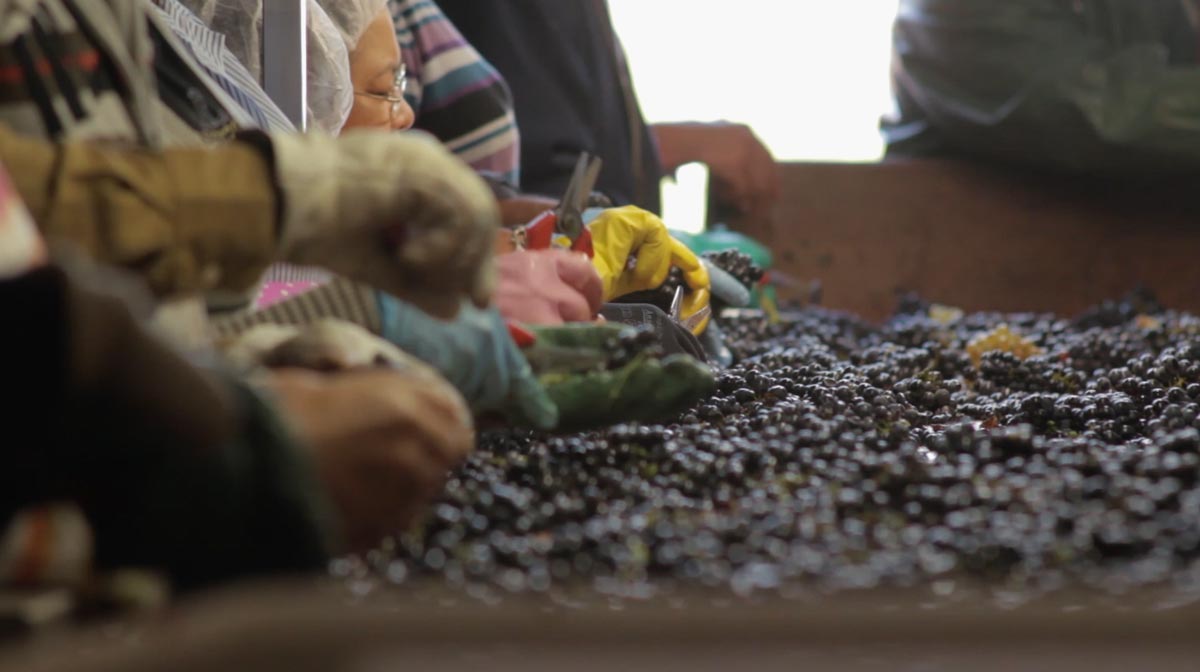
At harvest the fruit is picked into small cases, deliberately left underfilled so that nothing is crushed when they are stacked, and brought to the cellar in refrigerated vans. There as many as forty people work two sorting tables, and the bunches are sorted twice. The technique is unlike anything else on the Côte. Rather than destemming, the sorters cut away the hard upper section of each cluster and remove the central rafle, the woody spine of the bunch, by hand, leaving every berry hanging on its own pédicelle, the short stalk that attaches it. Nothing is crushed, and the bloom of wild yeast on the skins is left undisturbed.
Her reasoning is exact, and it is worth stating in her own terms, because it is often misreported. She wants neither the crushed fruit that destemming tends to produce nor a vat filled with whole bunches. She told William Kelley that she does not want “too many whole bunches or green stems,” which in her judgement work against the expression of the fruit and bring the wrong sort of tannin. What reaches the vat sits between the two, taking the freshness and the fine tannic frame that stems can give while leaving behind the greenness carried by the woody core. If the day’s picking outpaces the sorting, the fruit waits overnight in cold storage rather than being hurried through.
GET IN TOUCH
Talk to us about allocations, listings, or the wines themselves.
Trade
For sommeliers, restaurants,
hotels and merchants.
Allocations, pricing and
account opening.
About
Who’s behind Terroirs, and
how the portfolio is built.
Contact
Have a question?
We'd love to hear from you.
↑
☰